

Personal Brand for Leaders: The Gap Between Talented and Influential
Every interaction creates a perception. Most leaders treat this as something that happens to them. The empowering truth: you can actually influence what people think — not by becoming someone else, but by shifting what you do.
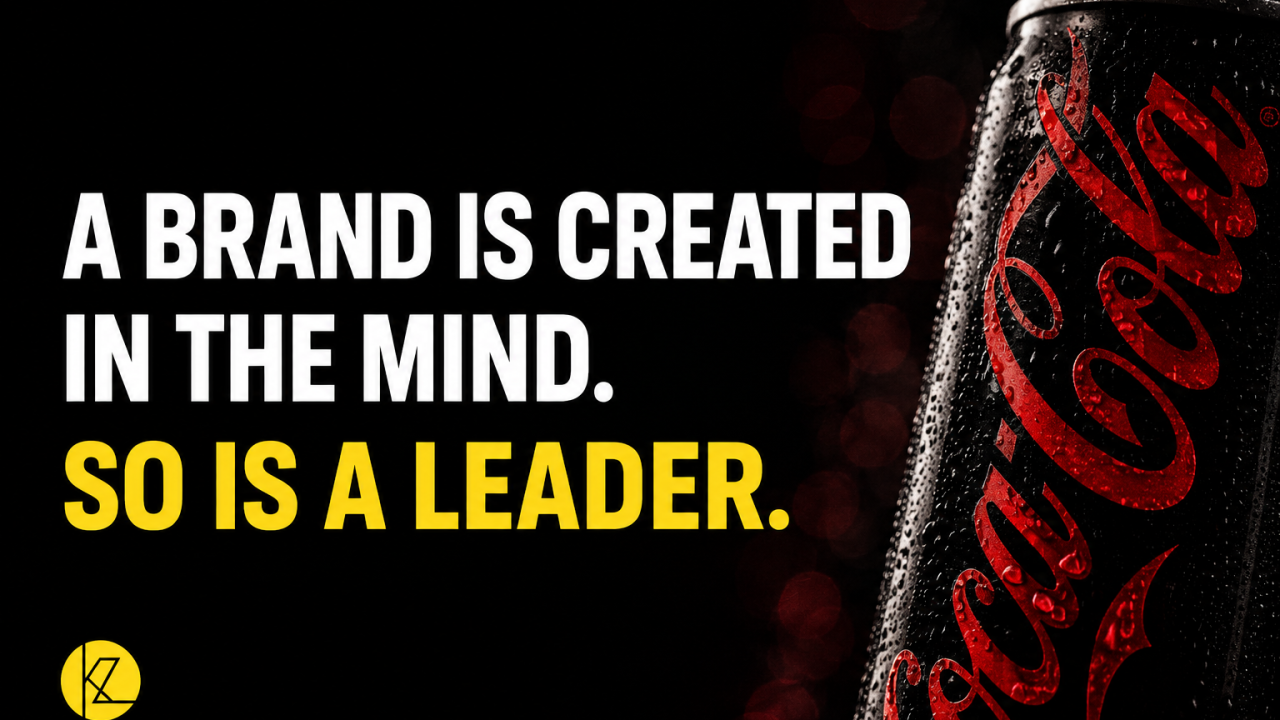
Products are made in the factory. Brands are created in the mind. So what’s been created about you?
The famous Coca-Cola script writing — the one you could draw from memory right now — was written in 1886 by a bookkeeper with good handwriting. It has barely changed since.
Which is what Walter Landor, who spent his life building brands, meant when he said this: Products are made in the factory, but brands are created in the mind.
Coca-Cola the product is sugar and water and a formula in a safe in Atlanta. Coca-Cola the brand doesn’t live in the bottle at all. It lives in your head — in what you think, what you’ve seen, how you felt the last time you held one on a hot day.
But we’re not talking about products. We’re talking about people, and that’s where this gets interesting.
We are not bottles of Coke
When I’m working with leaders, or with sales teams, or in a customer experience session, the thing on the table isn’t a product. It’s people. And the same rule applies.
Every time you pick up the phone, send an email, walk into a client meeting — you’re an ambassador for the organisation you’re part of. And in that same moment you’re creating something in the other person’s mind about you. What you’re like to deal with. Whether they’d want you back in the room, and whether they’d put your name forward when you’re not there to hear it.
A brand is created in the mind. So is a leader.
That’s happening whether you’re paying attention to it or not. It’s happening right now, in the meeting you’re about to walk out of.
The part people find empowering
I’ve spent the last decade in front of thousands of small business owners and thousands of leaders, and the good news I get to give them is that influencing perception doesn’t require becoming someone else.
Because we each have the ability to influence what people think of us. Not completely — and I want to be careful here, because there’s a lot of nonsense sold on this point. Who you are at your essence doesn’t change. Your personality is not a lever. If you’re an introvert, no amount of anything is going to make you a different animal, nor should it.
But above the fixed part there’s a whole layer that flexes, and most of it is behaviour rather than presentation. How you speak, what you do in the first ninety seconds of a room, whether you ask a second question instead of moving on. Whether you follow up when you said you would, on the day you said you would.
And let’s not stop at an outfit change, because that’s where this conversation usually stops and it’s the least of it.
What the great ones are doing
So think about the best leader you’ve ever worked for. Not the most successful one. The one people were drawn to.
I think of a GM I worked with in the NSW Government, Suzie Matthews. Everyone I knew, when I told them I was working for her, murmured oh, I love Suzie. She was innovative and approachable and kind, and she could cut through red tape to get to the best outcome for the team and the stakeholders both. When I left the department and started my own business she took the meeting, then introduced me to someone in her world, and that turned into a ripple of repeat work I’m still feeling.
She was an influencer in every sense of the word.
Now the opposite exercise, which is less comfortable. Think of someone in a team who’s technically excellent and has little influence. Their work is good — they’re brilliant, honestly. They’re just the best-kept secret, because nobody’s listening.
The gap between those two people is almost never capability, and rarely charisma in the way we usually mean that word. What separates them is a set of things happening underneath the conversation — the invisible human dynamics that make or break connection, and therefore make or break influence. Who feels safe here, who feels seen, who’s in and who’s sitting on the edge of it. None of it appears in any report anybody writes.
That’s the territory I’ve spent years mapping. It takes the shape of trust, tribe and thrive — The Connect Effect. Can I rely on you. Do I belong here. Can we do something good together. Those three things are what separate the invisible from the influential.
One human move: Check your label
If brands are created in the mind, the only question that matters is what’s actually in there. And you can’t work that out alone — it’s hard to read your label when you’re inside the jar.
So what’s your label?
Start with what you already have. Client testimonials, LinkedIn recommendations, the emails where somebody said thank you and meant it. Read twenty of them in one sitting and the common threads come up fast; people describe you more consistently than you’d expect.
Then ask. Text three people who’ve worked closely with you: What three words would you use to describe my influence? Text, not a call, so they can think. Don’t explain why you’re asking. Don’t defend the answers — thank them, and sit with it for a day.
Some of what comes back will be lovely. One of them will say something you didn’t intend.
You’re an influencer either way. The label just tells you which kind.
Kirryn Zerna helps people connect better for better results. A Certified Speaking Professional, author of The Stand Out Effect and a non-executive director, she works with organisations including Westpac, Woolworths and Carsales on the invisible human dynamics that shape trust, teams and performance. Her methodology, The Connect Effect, moves teams through Trust → Tribe → Thrive — one human move at a time.
FAQ’s
What makes a leader influential?
It’s rarely pure capability or charisma. It’s the invisible human dynamics underneath — whether people feel safe with you, seen by you, and like they’re part of something good. That’s trust, tribe and thrive.
Can you change how people perceive you?
Yes — but not by changing who you are. Your essence doesn’t shift. What does shift is behaviour: what you do in the first ninety seconds, whether you ask a second question, whether you follow up when you said you would. Small moves, repeated.
How do you know what people actually think of you?
Ask. Text three people who’ve worked closely with you and ask what three words they’d use to describe your influence. Then read your testimonials and recommendations in bulk — the patterns people use to describe you are remarkably consistent.
Related Posts
-
Repeat the Goal: Why Repetition Is a Leadership Advantage in Distracted Teams
May 28, 2026 -
What Taylor Swift Taught Me About Connection
May 31, 2024 -
Influence in Precedented Times
May 11, 2023 -
The Influencer Series is Back
May 4, 2023 -

Affinity & Connection in a Beyond Covid Culture
June 23, 2022