

The Three Types of Trust (and Which One Is Yours)
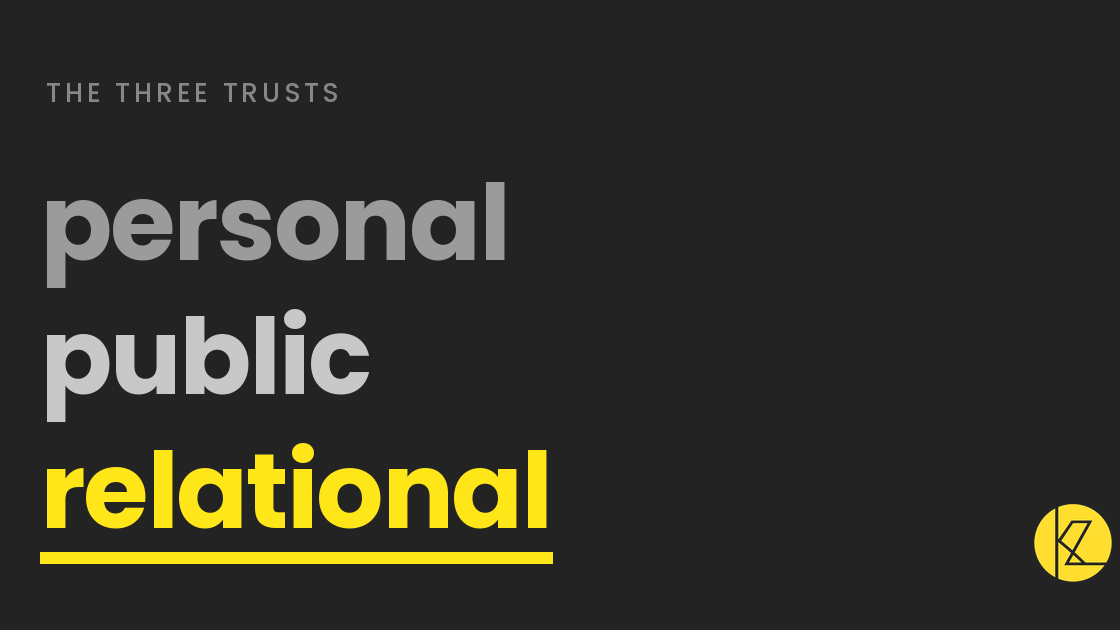
Most leaders treat trust as one thing to fix. It isn’t. There are three — personal, public and relational — and knowing which is yours changes what you do on Monday morning.
Last edition I wrote about the trust recession — how we arrive at a new financial year auditing everything except one of the most important things: trust. Why? Because decay rarely arrives in a single catastrophic moment. It shows up in the promise that wasn’t kept, the silence that went on too long, the person who stopped putting their hand up and nobody registered when.
That’s the work of The Connect Effect: the invisible human dynamics, the layer underneath the one we’re all watching.
But there’s something I notice every time I speak about this. I’ll ask a group what trust means to them, and back come the words — safety, reliability, honesty, care, respect. All true, all pointing in slightly different directions. Trust is one of those words that stretches to mean whatever we need it to mean, which makes it almost impossible to work with. If we can’t say what it is, we have no idea what to do on Monday morning to build more of it.
So let me tell you what I’ve come to believe. Trust isn’t one thing. It’s three.
Personal, public and relational — three different things we’ve been bundling under one tired word.
I ran a session recently with a room full of property managers, which turned out to be the perfect place to test this, so I’ll explain it the way I explained it to them.
Personal trust: doing what you said you’d do
Among that group was a young woman who works for a family property management business in a regional coastal town. Her team is thoughtful about how they treat landlords, tenants and each other, and people stay with them for years.
Picture the situation from the tenant’s side. Your bathroom sink gives way, water is moving across the floor, and you need someone to care about this as much as you do. You call. She says she’ll ring you back at four. At four o’clock, she rings.
The tap probably isn’t fixed, and that’s not the point. The point is that you now know the contractor is being called and the next step is happening, so you can put your phone down and get on with your day. She said four, and four is when the phone rang.
This is the layer where relationships hold or fracture, and it’s built almost entirely out of small things nobody would put in a performance review. It’s also the most systemisable of the three. Calendars hold the four o’clock call, and processes make sure the contractor gets rung and the email goes out. Her agency knows this, which is why they’ve built systems underneath the warmth rather than instead of it.
But reliability has a ceiling, because it only counts for the people who already know you exist.
Public trust: what people believe before you arrive
Property managers carry a reputation they didn’t personally earn. They sit between landlords and tenants, they’re handed the hardest conversations in the industry, and the public perception of the role arrives in the room before any individual does.
That agency has spent years rewriting the story — the way they present themselves as a family business, the photos, the website, the stories they choose to tell publicly. All of it slowly moving the perception from transactional to these are people who’ll look after both sides of this.
That’s reputation, and it does real work. It’s the reason someone takes your call, opens your proposal, or lets you into a conversation you haven’t yet earned.
We’ve all become fairly sophisticated at this layer. When something lands in my inbox from a stranger, I’ll search for them, and if there’s no site, no trace, no evidence they exist beyond the email, they’re not getting my money or my attention. Not because they’re untrustworthy, but because in the absence of a real relationship, reputation is all I have to go on. We’re all buying from a distance now.
Which is also why this is the layer we can increasingly hand over. AI helps with the messaging, the searchability, the presence — plenty of that work can be assisted or outsourced.
So reliability can be systemised and reputation can be assisted. Then there’s the third one, where none of that helps at all.
Relational trust: the permission to be real
Relational trust is the felt permission to be honest with each other, alongside a shared want for one another to do well. You can’t build it in a brand guide or schedule it into a workflow. It happens in the room, and it accumulates over time in a way that can’t be shortcut.
It’s what’s happening when she notices the landlord has gone silent and asks what’s really bothering him. It’s the fact that they both want this tenancy to work, and he can tell the difference between someone protecting a fee and someone who cares how it turns out.
When it’s missing, the first cost is information. You don’t get access to what you need to know. The landlord doesn’t mention the thing that’s been irritating him for four months until he’s already meeting other agencies, and the tenant doesn’t flag the small problem until it’s a legal one. Nobody says the true thing while it’s still cheap to say, so the early signal never reaches you. By the time the problem is loud enough to hear, it’s expensive.
The second cost is innovation. Nothing new gets offered. Nobody raises the better way of doing it or suggests the thing that might not work. And when people can’t try things and fail without consequence, the ideas stop arriving and you’ll never know what you didn’t get.
I’ve been part of teams where this was present, and you feel the difference immediately. You can say I don’t think that’s right to the most senior person in the room and watch them lean in. You can float something half-formed, be wrong on Tuesday, and have it forgotten by Wednesday. That freedom is where the good work lives, which is why relational trust matters commercially and not just humanly. Every high-performing team you’ve been part of had it, and every place where people checked out was missing it — usually while looking fine from the outside, because the systems were running and the reputation was intact.
That team has all three. They ring at four, they’ve built a reputation worth arriving ahead of them, and when they sit down across from a landlord, they actually see him. That’s why people stay.
So which one is yours?
Personal trust asks whether you do what you say you’ll do. Public trust asks what story arrives before you do. Relational trust asks whether people can be honest with you, and whether you’re both hoping for the same outcome.
Which one are you strongest in? Which is your opportunity area?
Some of us over-commit. Some of us smooth things over. Some of us do excellent work and stay invisible. And some of us are confident, capable, well-liked leaders but have something new to learn.
Once you can see which one is yours, the repair stops being mysterious. It becomes a move: one small decision, made repeatedly, in the layer that actually needs it.
That’s what the Trust Type assessment is for. It takes under five minutes and it isn’t a personality quiz. It’ll show you which of your three trusts is doing the heavy lifting, where the gap is, and the pattern underneath it — the way you tend to come undone under pressure, which is usually the part nobody has said out loud to you.
You can have immaculate systems and a reputation people admire and still lose the people who matter most, if they can’t be honest with you. The three trusts are the architecture, and the assessment tells you which one is yours to rebuild.
One human move this week: take the assessment, find your type, and make one move in the layer it points to.
→ Take the free Trust Type assessment
Kirryn Zerna helps people connect better for better results. A Certified Speaking Professional, author of The Stand Out Effect and a non-executive director, she works with organisations including Westpac, Woolworths and Carsales on the invisible human dynamics that shape trust, teams and performance. Her methodology, The Connect Effect, moves teams through Trust → Tribe → Thrive — one human move at a time.
FAQ
What are the three types of trust?
Personal trust (doing what you said you’d do), public trust (the reputation that arrives before you do), and relational trust (the felt permission to be honest with each other). Most teams are strong in one and quietly missing another.
Which type of trust matters most?
You need all three, but relational trust is the one you can’t systemise or outsource — and when it’s missing, the first cost is information and the second is innovation.
How do you rebuild trust?
Find which of the three is yours to work on, then make one small move in that layer, repeatedly. Repair is rarely one grand gesture; it’s a decision made again and again where it’s actually needed.
One Human Move publishes fortnightly. To enquire about keynotes and masterclasses, visit kirrynzerna.com.