

Gen Z Email Sign-Offs: What “Slay All Day” Reveals About Communication, Trust, and Leadership
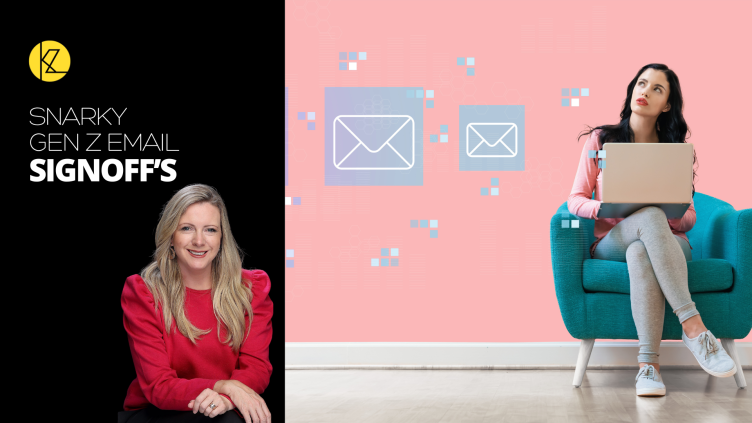
Warm Regards, Best Regards, Yours Truly, Cheers…
These are all email sign-offs that might sound a bit old-fashioned. Old, not just in terms of age, but in their traditional ways. Because there’s a new generation in town, and they’re rewriting the rules of work email signatures.
Now you might see:
- “Slay all day”
- “Cold regards”
- “Not a single regard”
And suddenly, the question isn’t just what sounds professional.
👉 It’s: What actually creates connection at work?
Now, speaking as one of the “experienced” folks, let me take a moment to ponder. What’s going on here?
The Rise of Gen Z Communication at Work
Like many trends, this one gained traction on social media.
(As is often the case these days, we stumbled upon this trend through TikTok.)
One notable example was a young lawyer, fittingly named @bodybytacobell, who became convinced that her boss wasn’t actually reading her emails. So, she started concluding her emails with witty and unusual sign-offs, just to see if they’d catch anyone’s attention.
And just like that, a trend was born. Gen Z employees across the board began to shake up their email game, ditching the formal sign-offs in favour of their own, often amusing, versions.
And what started as a joke became a signal:
👉 communication at work is changing
The result?
Others followed.
People noticed.
The Real Issue: Communication Is Evolving Faster Than Connection
At first glance, this might seem like a generational quirk.
But it points to something deeper.
In modern workplaces, we’re seeing:
- more communication
- more channels
- more speed
But not necessarily:
- more clarity
- more trust
- or stronger connection
And that’s where the tension sits.
The Leadership Challenge: Formality vs Authenticity
So who’s right? Why do we sometimes use overly formal language in our emails, using our “Yours sincerely,” when all we really mean is “Thanks.”
On the flipside, what happens when we throw out professionalism at work? Is it really OK to disregard professional ettiquette altogether? This aligns with a recent comment by Alex Mahon, chief executive of Channel 4, who suggested that young people are arriving in the workplace ill-equipped with the skills needed to communicate with colleagues; lacking the skills to debate or disagree.
Why This Matters for Teams and Performance
This isn’t just about email etiquette.
It’s about alignment.
When communication styles don’t match:
- messages are misinterpreted
- intent is unclear
- trust erodes
- and performance suffers
Because people don’t just respond to words.
👉 They respond to how those words feel.
Connection-Driven Leadership in Modern Workplaces
This is where Connection-Driven Leadership becomes critical.
Because today, leaders need to:
- bridge generational communication styles
- create clarity across different ways of working
- build trust — even when communication feels fragmented
And that doesn’t happen by default.
It’s led.
What Leaders Can Do Now
You don’t need to adopt “slay all day” in your emails.
But you do need to rethink how communication works in your team.
Start here:
1. Set clear communication expectations
Align on tone, style, and clarity across your team.
2. Build awareness across generations
Different styles aren’t wrong — they’re signals.
Use them to understand, not judge.
3. Focus on clarity and intent
Make sure messages are understood — not just sent.
So, here’s a question for you: What funny generational gaps or disconnections have you encountered in your workplace? Leave me a comment and let me know!
Planning a Leadership or Team Event?
Kirryn Zerna delivers keynotes on Connection-Driven Lhttps://www.kirrynzerna.com/speaker/eadership — helping organisations build trust, strengthen teams, and create high-performing cultures.
Related Posts
-
Repeat the Goal: Why Repetition Is a Leadership Advantage in Distracted Teams
May 28, 2026 -
Let’s Talk … The Connect Effect Concept
November 5, 2024 -
Can you Connect with a Story?
October 16, 2023